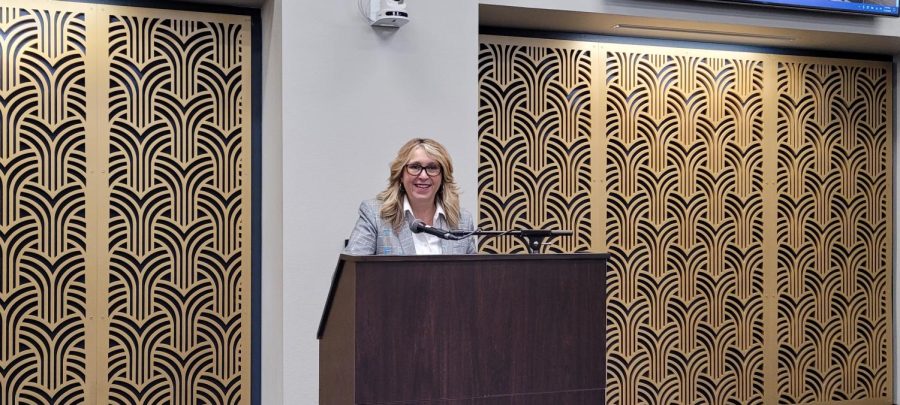
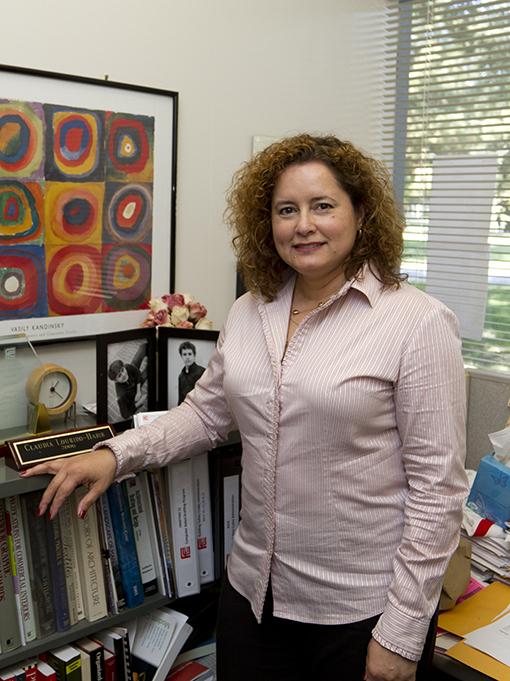
Throughout her youth Claudia Habib had witnessed injustice and inequity in Cali, Colombia. She had seen people desperately seeking shelter and she had desperately wanted to do something about it.
She knew the answer to her problems was education. But to find education she would have to flee her home at the age of 23 and land in the United States.
At first glance, she noticed it wasn’t exactly “Baywatch.” The transition would be a challenge thanks in large part to the language barrier. Nevertheless it was what she had dreamed of. The possibilities were finally within reach.
She would spend the first six months of her journey in the United States at Fresno Adult School. There she would work on her English and soon move on to Fresno City College. At FCC, Habib decided to chase the dream she had since she was a 14-year-old girl in Colombia.
She decided to major in architecture hoping to someday provide space for the homeless people she had seen in her country. Still struggling with English, Habib would spend countless hours with her books. With the little time remaining, Habib had to work and pay off her education. She would clean offices and houses or deliver pizza and newspapers.
As she cleaned, she did what she always does. She studied the architecture of buildings.
Despite the struggles, Habib found a home at FCC. She made friends and her instructors loved her. But after two years at FCC, it was time for Habib to move on. This time she would find herself at CSU Cal Poly. The transition proved to be even more difficult than before.
“Being at Cal Poly was a great experience but I felt like outsider. There were very few minorities. I didn’t have the support system I had at FCC,” said Habib. “There were very few Latinos and women in the architecture department. There was no money and working in the cafeteria was not enough. My Family didn’t see me. It wasn’t possible for them to travel from Fresno.”
Unable to sustain her stay at CSU Cal Poly, Habib returned to Fresno. She attended CSU Fresno and changed her major to interior design. Her personal life also saw some changes. She met and married a second generation Lebanese man, who was raised in the Ivory Coast. Before long she welcomed her first child. As life became more hectic, Habib struggled to find balance between life as a student, a wife and a mother. Still she remembered what she has always been told.
“My dad always said I must get an education. Like many immigrants, I saw education as way out of poverty, a way to obtain that American dream. I didn’t want to stop. I had to get that degree,” said Habib.
Habib would take 18-24 units a semester. She was finally rewarded in 1995 as she graduated with a bachelor’s degree in interior design from CSU Fresno. She graduated as student of the year and in the process established a strong portfolio.
Her success however, didn’t come without a heavy price.
“My baby didn’t know me. He didn’t call me mom. He didn’t even extend his hand to me. I was so busy studying,” said Habib.
Immediately after graduating, Habib found a job working for a design firm. There she worked for seven years. When FCC offered architects a job, she took advantage.
“It was heart-warming to come back to (FCC) after 10 years and work as a professional. I reconnected with people who made a difference in my life,” said Habib.
For two years Habib worked as an architect in the college. But when a teaching opportunity opened up in the architecture department, she was encouraged by a friend to go for it. Fearing her accent would be a barrier, Habib was reluctant at first. In the end however, Habib knew she was exactly what they were looking for.
“They needed somebody with experience of board drafting and computer drafting. All my training in Columbia was in board drafting. My training in the (United States) was in computer drafting,” said Habib, who became the first full time woman employed in the architecture division.
As Habib continued with her teaching career, she found it rewarding. She met students facing the struggles she experienced and she was thrilled to help them. 
The desire to learn was also very much within Habib. And so she returned to school and pursued a master’s degree from CSU Fresno. This time she obtained a degree in Instructional Technology from National University and decided to stop studying for good.
That plan however, was quickly demolished. She returned to school once more and obtained a doctorate in Education and Leadership from CSU Fresno.
By now Habib had become a mother of two boys. In a household where Columbian, Ivorian, and Lebanese culture mingled, the boys gained a rare insight. By the age of five, they spoke French, Spanish, and English. They traveled to the Ivory Coast, Lebanon, and France.
Adam, the oldest of the two boys, is now a sophomore at FCC, while Alex is a sophomore in high school.
Habib’s marriage has also been enriched by the mix of cultures. She is Catholic. Her husband is Muslim. But their values have brought them close together. They even share a passion for cooking.
“I love his cooking. And I love to cook Mediterranean food,” said Habib.
Despite a busy family life, Habib is always looking for a challenge. In addition to her teaching career, Habib is now the Academic Senate President at FCC.
“I became involved with the Academic Senate because I wanted a different perspective from the classroom. I figured I could see more of what is happening at the college and the district level. It’s also a way to understand the voices of the campus, a way to work with students, faculty, administrators,” said Habib. “I have learned to lead them, and also to respect others opinions. We all have one goal and that’s to help students. We just have different opinions on how to do that. Just being to talk about the issues is great.”
Particularly in a time of financial crisis, Habib is focused on working with legislations to bring change.
“There are a lot of things that are working but we may need to adjust a little bit. We need to focus on helping students get in, get out. It (the budget crisis) also has given us a chance to speak more about the community college. I don’t think we have done a good job of telling our story,” said Habib.
Her advice to young people is to persevere, to have a goal, to not give up and to get help.
“Life has its up and downs. We all have circumstances. You have to develop a support system,” said Habib. “I believe my family has made it here because we supported each other in our journey. We cannot do it by ourselves.”
Though she is not sure how long she will continue her career, Habib believes she will always be learning and teaching.
“I’m committed to community college at this point. I don’t see myself anywhere else,” said Habib. “We are teaching and learning every day. That’s a constant in my life.”





![[File Photo] On Wednesday, Feb. 19 Ed Madec coached what could be his final game as the Ram's head coach against the Reedley Tigers. Madec is currently under investigation for possible violations of CCCAA regulations.](https://www.therampageonline.com/wp-content/uploads/2020/03/Madec-900x600.jpg)