
Since the beginning of my middle school years, I have always done homework, taken exams, and checked grades online. This was also the time when having social media in my grade was a “must” for other students. A lot of people don’t think it’s a big issue, but there are so many ways our privacy is collected without us knowing.
There are reasons why you might have been talking about a restaurant you want to try out, or a specific situation you have going on out loud, and then suddenly you get that said content on your “for you page” even when you never searched it up.
Social media apps use an invisible tracker called “tracking pixels.” Tracking pixels listen in on what users do across other websites and devices.
Tracking pixels are small images that stay on our screens when we visit websites or even in our emails and track what we do.
The worry about our privacy and where our information went was never a major concern in my mind back then, but now it is definitely something all students should be cautious about.
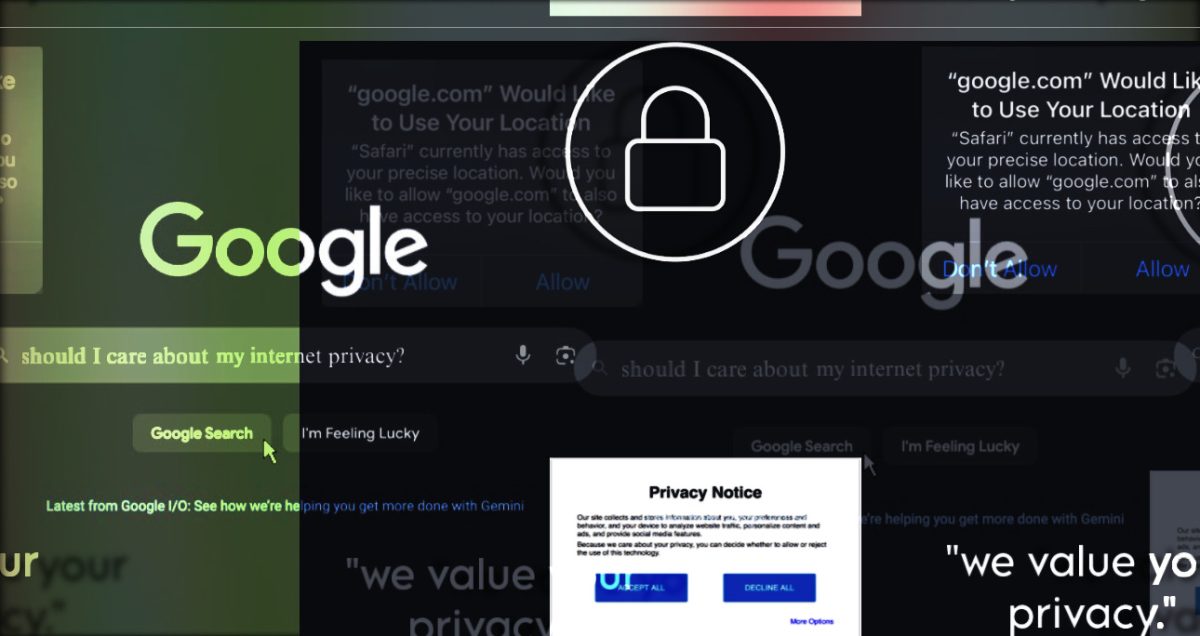
We don’t think twice when it comes to the little things online; our browsers, like Google and Safari, are some of the biggest ones.
This past September of 2025, Google was ordered to pay $425 million in a privacy lawsuit for violating smartphone users’ privacy and data, even while collecting it when users had the Web & App Activity feature off. The feature allows users not to share their location with sites like Google or Safari. Google also collected over 100 million Android users’ data without their consent in a new settlement this May.
Students are always doing research, and Google is one of the most popular search engines, used by over 170 million schools and universities, which is a concerning amount considering that we don’t know what they are doing with that data or how they are using it.
Search engines are not the only ones taking data. Social media apps like TikTok, Instagram, and my beloved Pinterest collect our personal data, and though they offer us the option to opt out of selling it, do we really think big platforms like this care enough to listen and not do it?
Meta, which at one point was set as the gold standard for user privacy, just removed end-to-end encryption, which was one of the most secure ways to message people without worry that third parties would access data and more.
Meta quietly added the feature this past March in their terms and conditions, stating that end-to-end encryption will no longer be supported after May 8, 2026.
For a company that was big on the slogan, “The future is private,” it doesn’t seem so private after all.
Internet privacy is not just invaded by companies taking advantage of us, but also by what we post or put out publicly.
It has become common to see a lot of students in my age group post their age, their hometown, and even which school they attend on social media all the time.
It is crucial that students don’t share personal identifiable information like their date of birth, full name, our location, and even accounts that link to our IDs, as hackers or people who want to gain that information can turn around and use it for identity theft and much worse.
Posting photos of the locations in the area someone lives in, or the school they attend, is also an easy way for people to catch onto personal daily routines. They can easily be found.
As students, both outside and on campus, we need to stay curious about where our information is going and how it can affect us in the future.
Though it may seem annoying or look like it isn’t a big deal, personal safety should always be number one.
Being able to take the extra steps to protect ourselves by limiting our personal information and what we share for everyone to see can help protect us and the peers around us.