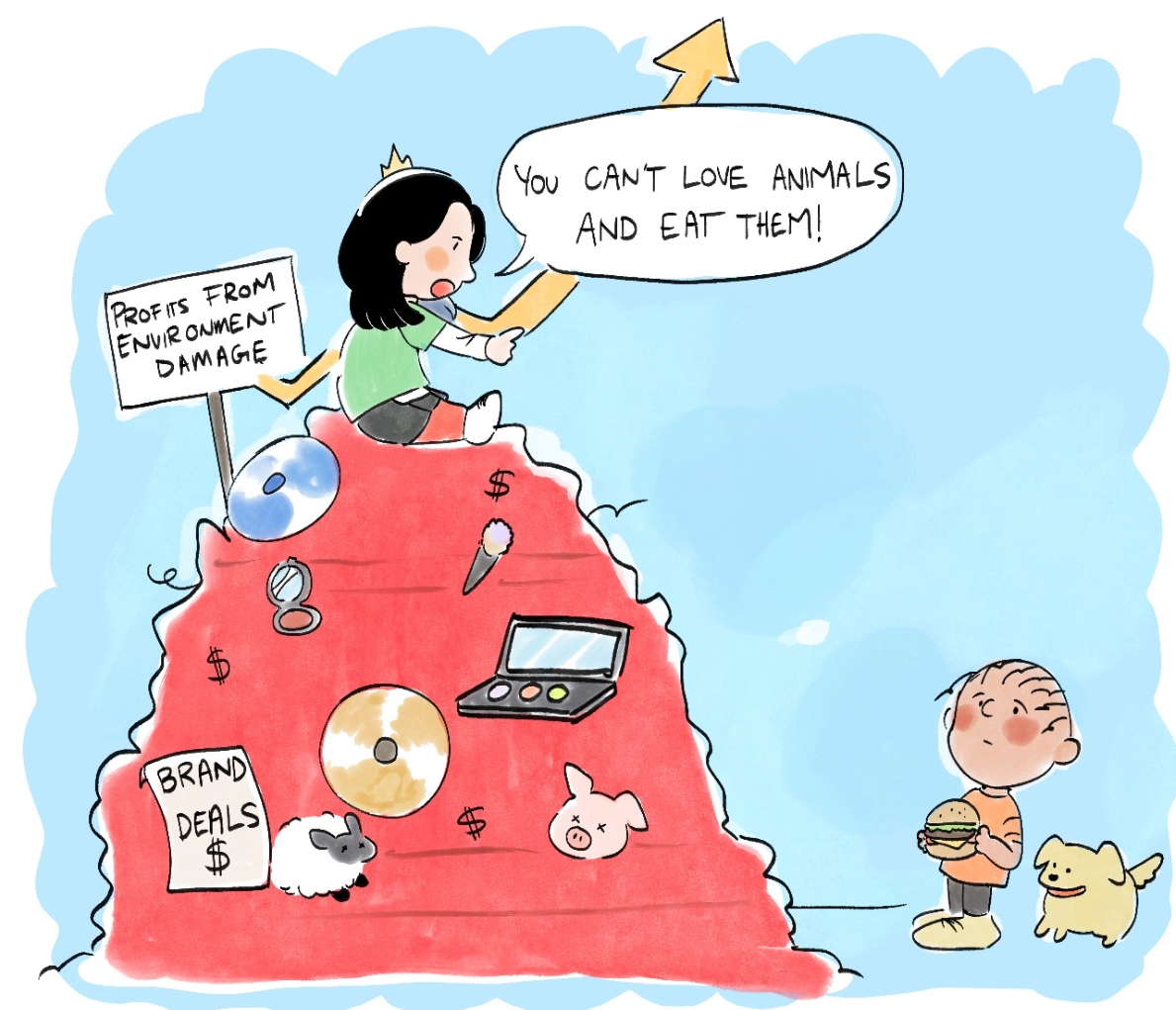
Billie Ellish recently caused controversy after stating that people cannot love animals and eat meat claiming they are direct contradictions in an interview by Elle Magazine.
Eilish said, “ You can eat meat! Go for it! You can love animals. But you can’t do both.”
On the surface, it seems like just another unpopular celebrity opinion that sparks conversation and publicity. However, when looking at the take a bit deeper, it is easy to see how disconnected and hypocritical wealthy celebrities truly are.
While people did agree with this, because it can be true when looking at it from the surface, what she didn’t take into account was the nuanced society that we live in. Generalized statements like this will always come across as privileged and overly simplistic.
For wealthy celebrities, veganism is far more accessible than it is for the average person. Celebrities often have personal chefs, nutritionists, expensive grocery budgets and the time to carefully plan meals. In contrast, many families are simply trying to afford food at all in today’s economy. Meat remains one of the cheapest and most practical ways for many people to get protein and nutrients, especially when feeding an entire household.
The issue is not that Eilish is vegan or that she advocates for animals rights. That is an important cause to support when many brands in and out of the food industry have a history of animal cruelty. The larger problem that I have is the hypocrisy that can be associated with celebrity activism.
Eilish heavily promotes ethical living and being sustainable. On her website, she includes a tab which shows how her team focuses on sustainability and recycling. For example, according to her website they use “organic and recycled fibers” when they can on her merchandise.
While doing this, she is also promoting brands such as Maybelline, a company owned by L’Oreal. Both have faced criticism regarding animal testing policies, seeing as neither are cruelty free certified by PETA or Leaping Bunny.
While Maybelline themselves have stated that they do not test on animals no outside fact-checking has been able to confirm that.
So while she preaches that she is vegan and that you can’t love animals whilst also eating them, she has no problem using and supporting brands that might test on animals.
It is hard to bash Eilish when so many celebrities use products like this. Why does it matter so much when she does it?
The contradiction and hypocrisy is what ultimately frustrates me. Celebrities put themselves in a morally superior position when focusing on their platform of what they believe in while also benefiting from the same corporate systems they criticize.
All to say, Billie Eilish is not the only celebrity who can be criticized for having disconnected opinions.
Jaden Smith went viral in 2018 after doing an interview where he made a comment that people his own age were not discussing the “economic and political state of the world.” While conversation surrounding this topic is very important, it can be difficult to hear it coming from someone that was born into extreme wealth.
Smith is the son of Will Smith and Jada Pinkett Smith, who are very famous and wealthy. While Jaden Smith did not choose to be born into this family, he has had opportunities and financial security that most young people will never have.
For many Americans, discussions about the economic state of the world aren’t just philosophical debates to bring up to your other wealthy friends, but their everyday lives. People are weighed down by upcoming rent charges, grocery prices and incurred debt.
Celebrities are able to discuss struggles of society and how it should be changed, then go home to their lavish lifestyles and remain disconnected from any repercussions of struggles.
Most celebrities aren’t perfect. When you have that much money and power it is impossible to not lose your sense of reality. You start promoting things that you shouldn’t, and all celebrities are subject to criticism from their audience. What makes the criticism bigger is when this disconnect from reality to get more money becomes hypocritical.
In an interview with Billboard, Eilish criticized major musicians for releasing multiple vinyl variants of one album. She claimed that she is an environmentalist and would not want to be wasteful like some bigger artist. People online started speculating that this was about Taylor Swift, although this was never confirmed.
Taylor Swift can be criticized for doing this, but she’s never claimed to be an environmentalist or sustainable, so I find Swift putting these variants out way less annoying than when Eilish does something. When Eilish’s album “Happier than Ever” dropped, it included at least eight different variants.
Swift and Eilish did the same thing, dropping a bunch of merch and physical pieces of media that felt like capitalist garbage, which is what Eilish is constantly fighting against. You cannot stand against capitalism, then stand right next to it when the dollar signs come rolling in.
The problem is not that Eilish isn’t perfect, no public figure is. The issue is when celebrities build brands around activism and morality while also participating in the same consumer culture.
She painted herself as a savior of the environment and everyone else as the villain, but at the end of the day also falters.
These moments highlight the growing frustration that regular people are starting to get with celebrity activism. They cannot speak up about issues as though they fully understand what the struggles of living actually are. They have become so separated from ordinary people by how many zeros follow the dollar sign that any take, no matter how valid it may be becomes invalid.
If the opinions by Eilish or Smith were presented to me by a friend, the response I give could have been way different. But with these conversations, taking into consideration who is presenting them is a big factor.
Celebrities are not wrong for caring about social issues, environmentalism or animal rights. However, when they speak on these topics from positions of extreme wealth and privilege, they should recognize that their lifestyles give them opportunities most people simply do not have. Otherwise, their messages risk sounding less inspiring and more disconnected from reality.